

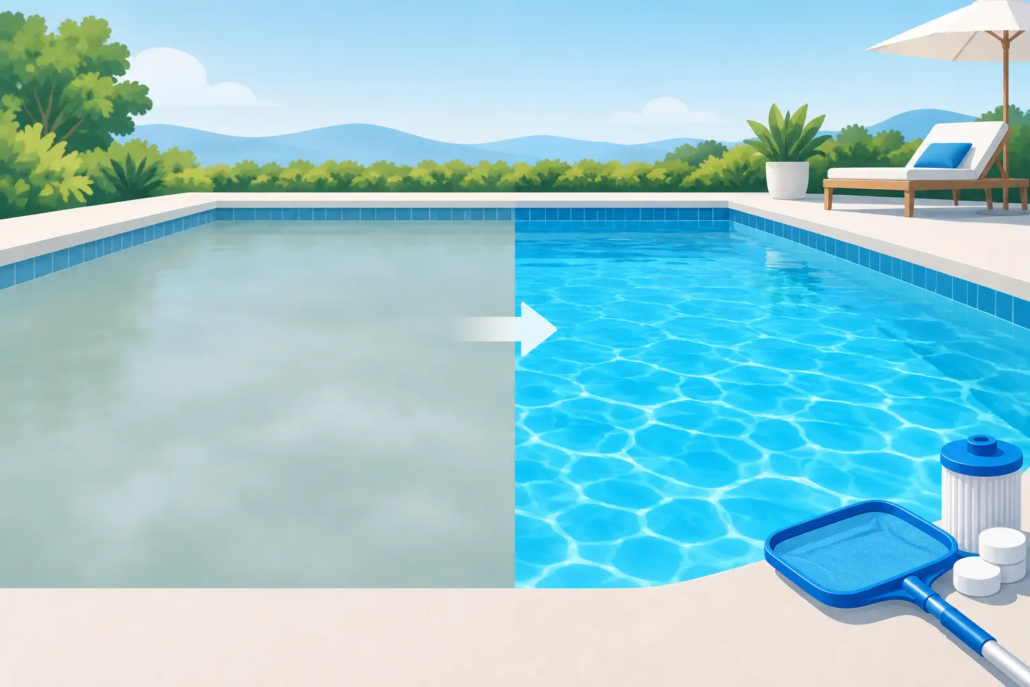
A pool can look fine one day and turn dull, hazy, or milky after a busy weekend, a heavy Central Florida rainstorm, or one missed service visit. That change is frustrating because the water may still look blue, yet you cannot clearly see the main drain or the floor in the deep end. Understanding why pool water turns cloudy helps you respond before a small water-balance issue becomes algae, damaged equipment, or a pool your family and guests should not use.
Cloudy water is not one problem with one fix. It is usually a sign that very small particles, microorganisms, or chemical byproducts are suspended in the water instead of being filtered out. The right correction depends on what caused the haze in the first place.
Why Pool Water Turns Cloudy
Most cloudy-pool problems fall into three connected areas: water chemistry, circulation and filtration, or contaminants entering the pool. In many cases, more than one issue is happening at once.
Sanitizer is too low or not working effectively
Chlorine is meant to kill bacteria, control algae, and break down contaminants brought in by swimmers, rain, leaves, sunscreen, and body oils. When the chlorine level drops too low, the pool loses its ability to keep up. Early algae growth and other microscopic material can make the water look cloudy before it turns visibly green.
A chlorine reading alone does not always tell the full story. High pH reduces chlorine’s effectiveness, while a high stabilizer level can make chlorine less active. In Florida, stabilizer can gradually build up when certain chlorine products are used repeatedly. The water may test as if it has chlorine, but that chlorine may not be doing enough work.
For saltwater pools, cloudy water can also point to a salt cell that needs cleaning, reduced output settings, or a cell nearing the end of its service life. The pool still needs consistent testing and adjustment, even when a salt system is producing chlorine.
pH, alkalinity, and calcium are out of balance
Clear pool water relies on balanced chemistry, not just sanitizer. When pH rises too high, minerals such as calcium can come out of solution and form tiny particles. Those particles scatter light, creating a cloudy or whitish appearance. You may also notice scale on tile, a rough pool surface, or white buildup around returns.
Low pH and low alkalinity create a different set of concerns. They can make water corrosive and unstable, which often causes pH to swing after rain, heavy use, or chemical additions. Calcium levels that are too low or too high can contribute to cloudy water as well, especially in hard-water conditions.
Trying to correct every number at once is a common mistake. Adding multiple chemicals without retesting can overshoot the target and make the water harder to balance. A measured approach is safer for swimmers, the pool surface, and the equipment.
The filter cannot remove fine particles
Your filter is the system that removes the small debris and particles causing the haze. If it is dirty, undersized, damaged, or not running long enough, cloudy water can remain even when the chemistry is close to correct.
A cartridge filter needs periodic rinsing and occasional deep cleaning. A sand filter requires backwashing when pressure rises and may need fresh media over time. A DE filter needs proper backwashing and recharging with DE powder. Each filter type has different maintenance needs, but all depend on adequate water flow.
Check the pressure gauge and compare it with your normal clean-filter pressure. A higher reading often means the filter needs attention. A pressure reading that is unusually low can signal a suction-side blockage, air leak, pump issue, or a gauge that is not working correctly.
Circulation is too weak or too short
Water cannot be filtered or sanitized properly if it is not moving through the system. A clogged skimmer basket, blocked pump basket, closed valve, dirty filter, failing pump, or low water level can reduce circulation. Dead spots, particularly around steps, ledges, corners, and behind ladders, give algae and debris a place to collect.
Run time matters, too. Orlando heat, strong sun, and frequent summer storms put a higher demand on a pool than mild-weather conditions. There is no single schedule that fits every pool. Pump run time should account for pool size, equipment speed, bather load, weather, and whether the water has recently needed recovery.
If you have a variable-speed pump, running it at a lower speed for a longer period is often efficient, but the system still needs enough flow to skim, circulate chemicals, and filter the full volume of water. A pool that looks cloudy every afternoon may need a circulation adjustment rather than another round of chemicals.
Rain, pollen, debris, and swimmers add contaminants
Central Florida pools deal with a steady supply of organic material. Wind can blow in pollen, grass, leaves, soil, and mulch. Summer rain dilutes chemicals and carries fine debris into the water. A full pool day adds sweat, sunscreen, lotions, and other contaminants that use up chlorine.
These materials are not always visible as floating debris. Many are small enough to stay suspended and make the water appear dull. After a storm or party, skimming alone is rarely enough. The pool may need testing, brushing, vacuuming, filter cleaning, and a chemistry adjustment to return to a clear condition.
Is Cloudy Pool Water Safe to Swim In?
If you cannot clearly see the pool floor, especially the main drain, keep swimmers out until the water is clear. Visibility is a safety issue. In an emergency, cloudy water can make it difficult to see someone underwater.
Cloudiness can also indicate poor sanitation or early algae activity. While not every cloudy pool contains harmful levels of bacteria, the water should be tested and corrected before use. Do not rely on appearance alone, and do not assume that adding a large amount of chlorine is automatically the right solution.
How to Clear Cloudy Pool Water the Right Way
Start by removing obvious debris, emptying the skimmer and pump baskets, and confirming that the water level is high enough for the skimmer to work. Then test the water with a reliable method for free chlorine, pH, total alkalinity, stabilizer, and calcium hardness. If the pool uses a salt system, confirm the salt level and inspect the cell as needed.
Next, make one targeted chemical correction at a time and allow the water to circulate. Brush the walls, steps, and floor to loosen material that could be feeding algae or settling in low-flow areas. Run the pump long enough to filter the water thoroughly, watching filter pressure and cleaning or backwashing when needed.
If the water is blue but still hazy after chemistry and filtration are addressed, a properly selected clarifier may help the filter capture fine particles. This is not a substitute for correcting the underlying issue. Too much clarifier can create its own filtration problems, so follow product directions carefully.
A flocculant can sometimes clear severe cloudiness by causing particles to settle to the bottom for vacuuming to waste. It can be effective, but it is more labor-intensive and may waste a significant amount of water. It is generally better reserved for situations where normal filtration and balanced chemistry are not clearing the pool.
When Cloudy Water Needs Professional Attention
Call for service if the water remains cloudy after proper testing, circulation, and filter maintenance, or if it shifts toward green, yellow, or black. Persistent cloudiness can point to algae, a failing pump, a cracked filter component, a clogged line, high stabilizer, or a chemical imbalance that needs more precise diagnosis.
For rental homes, community pools, and other managed properties, quick action matters even more. Cloudy water affects resident confidence, pool safety, and the appearance of the property. Consistent documented service helps catch rising pressure, falling sanitizer, and early algae before they disrupt access to the pool.
Pro Backyard Pool provides chemical-only service for owners who prefer hands-on cleaning and weekly full-service maintenance for those who want the entire routine handled. The goal is not simply to make the water look better for a day. It is to keep it healthy, balanced, filtered, and ready to enjoy.
A clear pool is usually the result of small, consistent checks rather than emergency treatments. After storms, busy swim days, or a change in how the water looks, address the cause early. That gives your pool the best chance to stay blue, clear, and clean when your family is ready to use it.








Leave a Reply
Want to join the discussion?Feel free to contribute!