

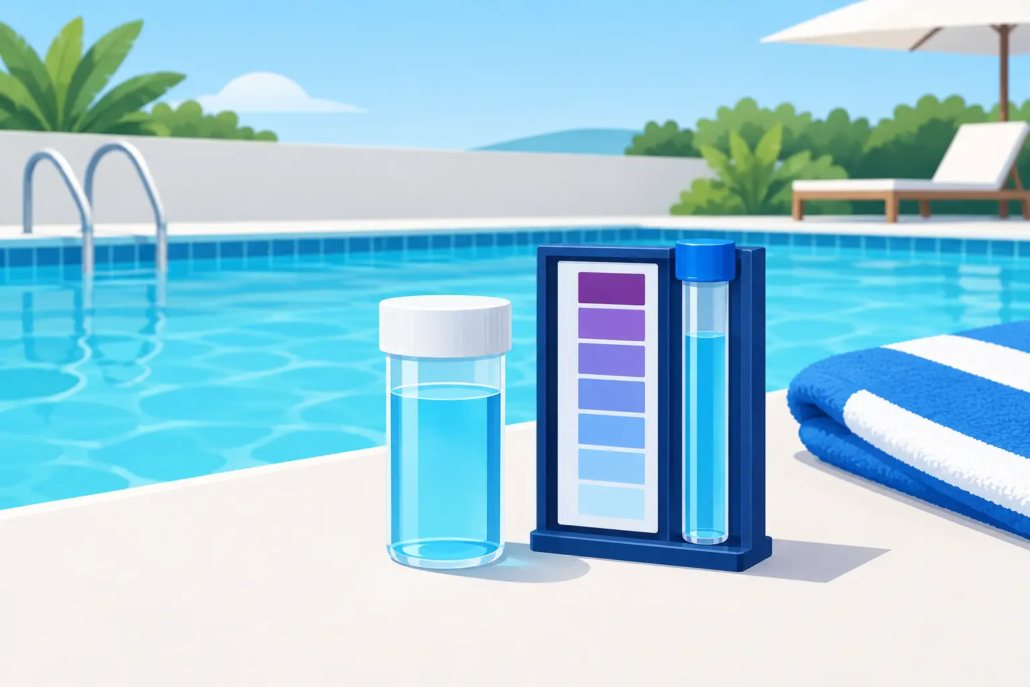
A pool can look blue and still have a chemistry problem. In Central Florida, intense sun, frequent rain, and year-round swimming can change water balance quickly. Knowing how to test cyanuric acid helps you protect the chlorine already in your pool, prevent avoidable algae, and keep the water clear, clean, and comfortable.
Cyanuric acid, often called CYA or conditioner, is not a sanitizer. Its job is to shield chlorine from sunlight. Without enough CYA, the Florida sun can burn through chlorine before it has time to do its work. Too much CYA creates the opposite problem: chlorine becomes less effective, even when a basic test shows a normal chlorine reading.
Why Cyanuric Acid Testing Matters
CYA acts like sunscreen for chlorine, but every pool needs the right amount. A low reading can lead to rapid chlorine loss, frustrating chemical use, and water that struggles to stay clear. A high reading can make algae harder to prevent and eliminate because more chlorine is needed to sanitize effectively.
This is why homeowners should not rely on chlorine readings alone. If chlorine seems to disappear overnight, the pool stays cloudy after heavy use, or algae returns despite regular treatment, cyanuric acid should be part of the diagnosis.
For most residential outdoor pools using traditional chlorine, a CYA level of about 30 to 50 parts per million, or ppm, is a practical target. Saltwater pools often operate best at roughly 60 to 80 ppm, depending on the salt system manufacturer. Commercial pools may have stricter local requirements, so property managers should follow their pool regulations and equipment guidance.
How to Test Cyanuric Acid With a Pool Test Kit
The most dependable at-home method is a liquid reagent test kit with a CYA mixing bottle and a viewing tube marked with a black dot. Test strips can provide a quick estimate, but liquid testing is generally more useful when you need to make a chemical decision.
Start by taking a water sample from elbow depth, away from return jets, skimmers, and chemical feeders. Surface water can be affected by recent rain, sunscreen, leaves, or freshly added chemicals, so a deeper sample gives a better picture of the pool as a whole.
Use the black-dot test correctly
Fill the mixing bottle with pool water to the marked line. Add the cyanuric acid reagent according to the kit instructions, usually in an equal amount. Cap the bottle and gently shake it for about 30 seconds. The mixture should become cloudy.
Next, slowly pour the mixed sample into the viewing tube while looking straight down at the black dot on the bottom. Stop when the dot disappears from view. Read the CYA level at the water line on the tube.
This test works by measuring cloudiness, so lighting and technique matter. Perform it outdoors with your back to the sun, but do not look directly into bright glare. Hold the tube at about waist level and avoid squinting or leaning over it. If you can still see the black dot, add more sample. If it disappears immediately, your cyanuric acid may be very high.
For a more confident result, repeat the test once or twice using the same water sample. The readings should be reasonably close. If they vary widely, check that the tube is clean, the reagent is not expired, and you are using the same lighting position each time.
Test strips are useful for quick checks
CYA test strips are convenient when you want a fast weekly overview. Dip the strip for the time listed on the container, hold it level while the colors develop, and compare it to the chart in natural daylight. Do not read strips after the recommended time, since colors can keep changing as they dry.
The trade-off is precision. A strip may tell you that CYA is around 30, 50, or 100 ppm, but it may not identify a borderline reading accurately enough for a major adjustment. Use strips for routine monitoring and a liquid test or professional water analysis before draining water or making a large chemical change.
When to Test Cyanuric Acid
For a stable residential pool, testing CYA once a month is usually enough. In Orlando and nearby communities, test sooner after several days of heavy rain, a large water replacement, repeated shock treatments, or an algae issue.
CYA does not evaporate. It typically rises when you use stabilized chlorine products, such as trichlor tablets or dichlor shock. It drops only when water leaves the pool through draining, splash-out, backwashing, overflow, or a leak, then is replaced with fresh water.
That pattern explains a common problem. A pool owner may use tablets steadily because they are convenient, then find months later that chlorine no longer seems to hold. The tablets added sanitizer, but they also added cyanuric acid each time. Regular testing catches that rise before it becomes an expensive green-pool recovery.
How to Read Your Cyanuric Acid Result
A reading below 30 ppm in an outdoor chlorine pool means sunlight may be consuming chlorine too quickly. Add a cyanuric acid conditioner slowly and follow the product dosage instructions for your pool volume. Do not add more based on a same-day retest. CYA can take 24 to 48 hours to dissolve and circulate fully, especially if it is added through a skimmer sock or placed in front of a return.
A reading between 30 and 50 ppm is a solid range for many manually chlorinated residential pools. Continue checking free chlorine regularly, because CYA protects chlorine but does not replace it.
A reading between 60 and 80 ppm may be appropriate for many saltwater pools. For a non-salt pool, however, this range often calls for closer chlorine management. The higher the CYA, the higher the free chlorine level generally needs to be for reliable sanitation.
A reading above 100 ppm deserves attention. Test kits can become less precise at high levels, and very high CYA can make chlorine management difficult. The practical correction is usually to partially drain and refill the pool with fresh water, then retest after the water has circulated. Never drain a pool without considering groundwater conditions, pool construction, and professional guidance. In Central Florida, a high water table can create real risks for certain pools if water is removed improperly.
Avoid These Common Testing Mistakes
Do not test immediately after adding chemicals. Give the pump time to circulate the water, usually at least several hours. Do not use expired reagents, store test supplies in direct heat, or assume a pool-store result is automatically correct if it conflicts with your own repeatable test. A second test is often the fastest way to resolve a surprising number.
Also, avoid treating CYA as an isolated number. Free chlorine, pH, total alkalinity, calcium hardness, water temperature, bather load, and circulation all affect how a pool performs. A balanced pool is not simply one that passes a single test.
Keep Chlorine and CYA Working Together
The goal is not to chase a perfect number every day. The goal is water that stays healthy between services: chlorine that holds, surfaces that stay free of algae, and a pool your family or guests can enjoy without uncertainty.
If your CYA is repeatedly too low, too high, or difficult to interpret, a consistent chemical service can save time and prevent small issues from growing. Pro Backyard Pool helps Orlando-area homeowners and property managers stay ahead of changing water conditions with dependable testing, clear communication, and care focused on keeping pools blue, clear, and clean.








Leave a Reply
Want to join the discussion?Feel free to contribute!